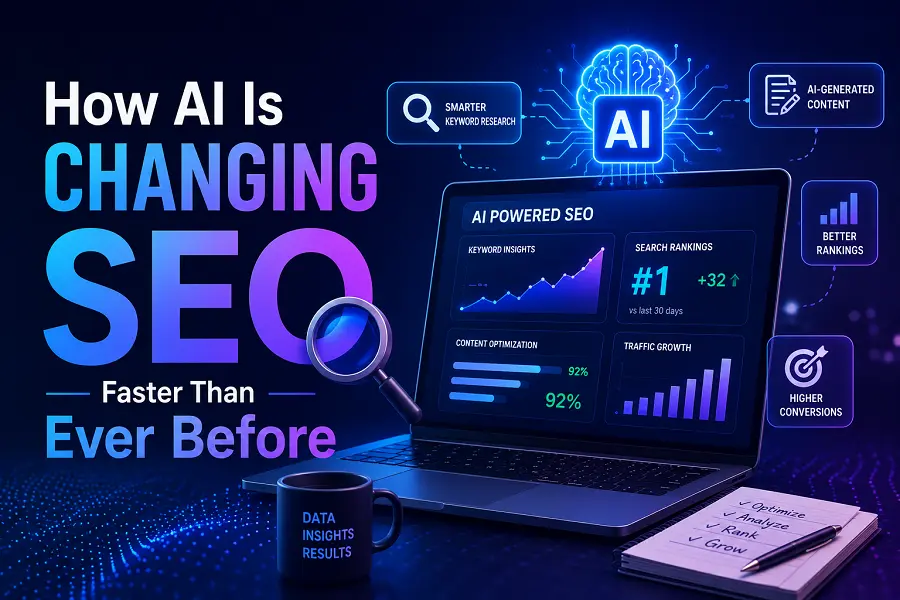
Artificial intelligence is reshaping search engine optimization at a remarkable pace. Tasks that once required hours of manual work can now be completed in minutes, while search engines have become better at understanding context, intent, and content quality. This shift means businesses can no longer rely on outdated SEO tactics or keyword-heavy pages. Success now depends on creating useful, trustworthy, and well-structured content that genuinely answers users’ questions.
How AI Is Transforming Modern SEO
AI has changed nearly every stage of the SEO process, from keyword research to content optimization and performance analysis. Instead of focusing on isolated keywords, search engines now evaluate how well a page satisfies user intent.
Businesses and content creators are adapting by:
- Creating content around topics instead of individual keywords.
- Improving content relevance with natural language.
- Understanding search intent before publishing.
- Optimizing for conversational and voice searches.
- Updating older content to maintain freshness.
- Identifying technical SEO issues more efficiently.
- Delivering personalized user experiences.
As AI continues to evolve, quality becomes a stronger ranking factor than content quantity.
Practical Ways to Adapt Your SEO Strategy
Rather than competing with AI, successful marketers use it to improve efficiency while keeping human expertise at the center.
- Research user intent before selecting keywords.
- Build comprehensive content that answers related questions.
- Write naturally instead of forcing exact-match keywords.
- Add real-world examples and practical advice to demonstrate expertise.
- Keep articles updated as search behavior changes.
- Improve page speed, mobile usability, and navigation.
- Use AI tools to assist with research, outlines, and optimization—not to replace thoughtful writing.
- Monitor search performance and refine content based on user engagement.
A balanced approach helps websites remain competitive while meeting modern search expectations.
Why Human Expertise Still Matters
Although AI can generate drafts, analyze data, and automate repetitive tasks, it cannot replace genuine experience, critical thinking, or industry knowledge. Readers trust content that solves real problems, explains complex topics clearly, and offers practical guidance.
Google increasingly rewards content that demonstrates experience, expertise, authority, and trustworthiness. That means businesses should focus on publishing accurate information, answering specific questions, and maintaining consistency across their websites.
The future of SEO is not about choosing between AI and humans. It is about combining AI-powered efficiency with authentic human insight to produce content that serves users first. Websites that prioritize value, clarity, and credibility are more likely to earn sustainable search visibility as AI continues to influence how search engines rank content.
Conclusion
AI has accelerated the evolution of SEO, making search more intelligent and user-focused than ever before. Traditional optimization methods are giving way to content built around intent, quality, and genuine expertise. Businesses that embrace AI as a productivity tool while continuing to create original, helpful, and trustworthy content will be better positioned for long-term search success. The winning strategy is no longer simply ranking higher—it is consistently delivering the best answer to every searcher’s question.
FAQs
1. How is AI changing SEO?
AI improves keyword research, content optimization, search intent analysis, technical SEO, and user experience, making SEO more efficient and focused on quality.
2. Can AI replace SEO professionals?
No. AI assists with research and automation, but strategic planning, creativity, industry expertise, and audience understanding still require human involvement.
3. Does AI-generated content rank well?
Content can perform well when it is original, accurate, helpful, and demonstrates genuine expertise. Quality matters more than how the content is created.
4. What skills are becoming more important in SEO?
Understanding user intent, topical authority, technical SEO, content strategy, data analysis, and creating valuable user experiences are increasingly important.
5. Should small businesses use AI for SEO?
Yes. AI can help small businesses save time with research, optimization, and content planning while allowing them to focus on providing unique expertise and customer value.