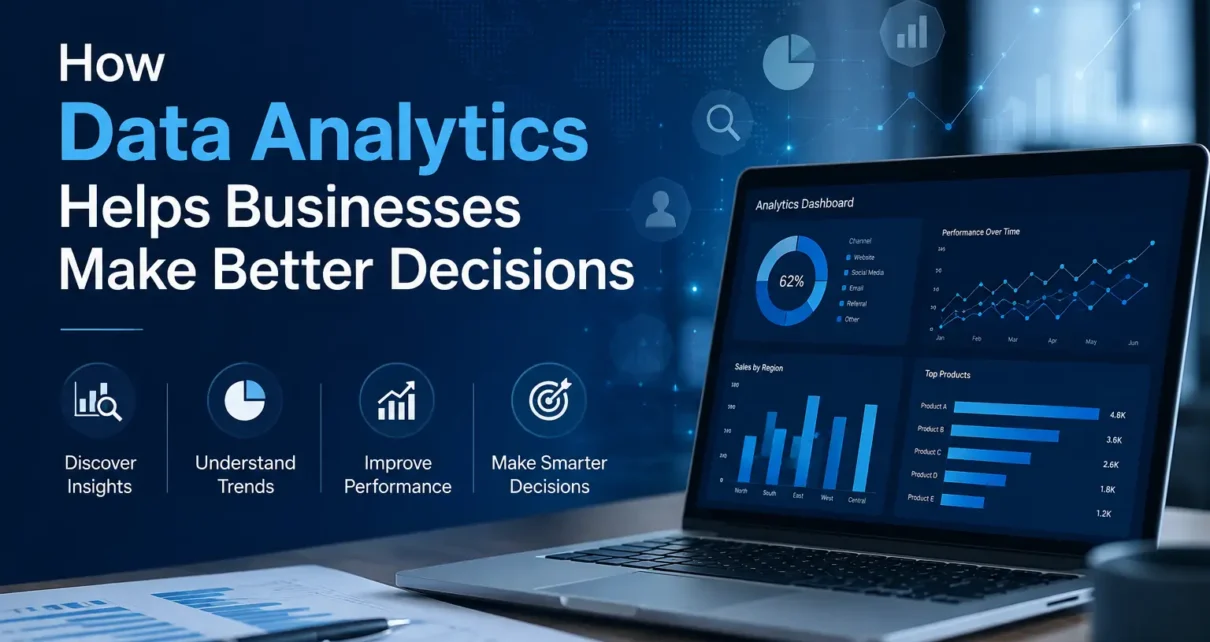
Business decisions shape growth, profitability, and customer satisfaction. Relying on assumptions or outdated reports can lead to missed opportunities and costly mistakes. Data analytics gives organizations a clearer understanding of their operations, customers, and market trends by turning raw information into meaningful insights.
Instead of guessing what might work, businesses can evaluate real performance, identify patterns, and make informed choices with greater confidence. Whether a company is small or large, using data effectively creates a stronger foundation for planning and long-term success.
How Data Analytics Improves Business Performance
Data analytics helps organizations understand what is happening across every part of the business. It combines information from sales, marketing, finance, customer service, and operations to reveal trends that might otherwise go unnoticed.
Key benefits include:
- Identifying profitable products and services.
- Understanding customer buying behavior.
- Tracking employee and operational performance.
- Detecting inefficiencies that increase costs.
- Improving inventory and supply chain planning.
- Measuring the success of marketing campaigns.
- Supporting faster and more accurate decision-making.
- Reducing uncertainty before making major investments.
When businesses consistently monitor reliable data, they can respond more quickly to changing market conditions instead of reacting after problems become serious.
Practical Ways Businesses Use Data Analytics for Better Decisions
Organizations apply analytics in different areas depending on their goals. Rather than replacing human judgment, analytics strengthens decision-making by providing factual evidence.
- Understanding Customer Preferences
Purchase history, browsing behavior, and customer feedback reveal what customers value most. This helps businesses personalize offers and improve customer experiences. - Improving Sales Strategies
Sales data highlights which products perform well, seasonal buying patterns, and the most effective sales channels. Teams can focus their efforts where they generate the highest return. - Managing Business Risks
Analytics identifies unusual patterns, financial irregularities, and operational issues before they become major problems, allowing businesses to take preventive action. - Optimizing Operational Efficiency
Production schedules, delivery times, and workflow performance become easier to monitor, helping managers reduce delays and eliminate unnecessary expenses. - Supporting Financial Planning
Revenue trends, expense tracking, and profit analysis provide a realistic picture of business performance, making budgeting and forecasting more accurate. - Strengthening Marketing Decisions
Businesses can evaluate campaign performance using measurable results instead of assumptions. Marketing budgets can then be allocated to strategies that deliver better outcomes.
Best Practices for Getting Value from Data Analytics
Collecting data alone does not improve business decisions. Success depends on how information is managed, interpreted, and applied.
Businesses achieve better results by:
- Setting clear business objectives before collecting data.
- Focusing on relevant metrics instead of tracking everything.
- Maintaining accurate and up-to-date data.
- Combining data from multiple business functions.
- Training employees to understand reports and dashboards.
- Reviewing analytics regularly rather than only during major projects.
- Turning insights into measurable business actions.
Organizations that build a data-driven culture encourage every department to use evidence when solving problems and planning future initiatives.
Conclusion
Data analytics enables businesses to replace uncertainty with informed decision-making. By analyzing customer behavior, operational performance, financial trends, and market opportunities, organizations gain valuable insights that support smarter strategies and sustainable growth.
Businesses that consistently use data analytics are better equipped to improve efficiency, reduce risks, identify new opportunities, and adapt to changing market conditions. As competition continues to increase, making decisions based on reliable data becomes a significant advantage rather than an optional practice.
FAQs
1. What is data analytics in business?
Data analytics is the process of examining business data to discover patterns, trends, and insights that support better decision-making and improve overall performance.
2. Why is data analytics important for small businesses?
Small businesses can use analytics to understand customers, manage expenses, improve marketing effectiveness, and make informed growth decisions with limited resources.
3. How does data analytics improve customer satisfaction?
Analytics helps businesses understand customer preferences, identify common issues, personalize experiences, and deliver products or services that better meet customer expectations.
4. Can data analytics reduce business risks?
Yes. It helps identify unusual patterns, monitor financial performance, detect operational problems early, and support proactive decision-making before risks escalate.
5. Which departments benefit most from data analytics?
Sales, marketing, finance, operations, customer service, and human resources all benefit by using data to improve planning, efficiency, and business outcomes.