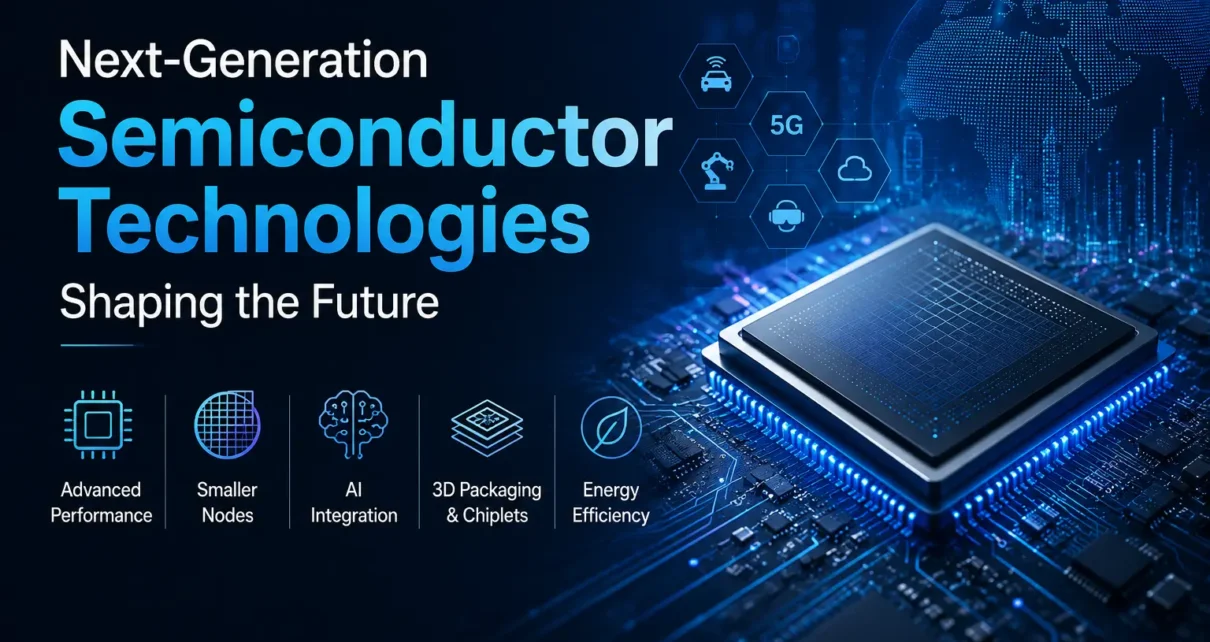
Semiconductors are the foundation of modern electronics, powering everything from smartphones and electric vehicles to data centers and medical devices. As computing demands continue to grow, traditional chip manufacturing approaches are reaching physical and performance limits. This has accelerated the development of next-generation semiconductor technologies that deliver higher speed, improved energy efficiency, and greater processing capability. Understanding these innovations helps businesses, engineers, and technology enthusiasts prepare for the next wave of digital transformation.
How Next-Generation Semiconductor Technologies Are Evolving
The semiconductor industry is moving beyond simply shrinking transistors. Manufacturers are combining new materials, advanced chip architectures, and innovative packaging methods to improve overall performance.
Key developments include:
- Smaller transistor designs with improved power efficiency.
- Three-dimensional chip stacking to increase computing density.
- Advanced chiplet architecture for flexible processor design.
- Wide-bandgap semiconductor materials for high-power applications.
- AI-optimized processors built for machine learning workloads.
- Improved thermal management for better reliability.
- Low-power semiconductor designs for IoT and wearable devices.
- Enhanced manufacturing techniques that reduce defects and improve yield.
These innovations allow electronic devices to process larger workloads while consuming less energy, making them suitable for demanding applications across multiple industries.
Industries Benefiting from Advanced Semiconductor Technologies
Next-generation semiconductor technologies are transforming products and services across many sectors.
-
Artificial Intelligence
Specialized AI accelerators process complex algorithms faster than conventional processors, enabling smarter applications and faster decision-making.
-
Automotive
Modern vehicles rely on advanced semiconductors for driver assistance systems, battery management, autonomous driving, and in-vehicle connectivity.
-
Healthcare
Medical imaging systems, wearable health monitors, and diagnostic equipment benefit from smaller, faster, and more energy-efficient semiconductor chips.
-
Telecommunications
High-performance chips support 5G infrastructure, faster wireless communication, and lower network latency.
-
Industrial Automation
Smart factories use advanced processors for robotics, predictive maintenance, machine vision, and real-time production monitoring.
-
Consumer Electronics
Smartphones, laptops, gaming devices, and smart home products continue to gain better battery life and higher performance through semiconductor innovation.
Challenges and the Future of Semiconductor Innovation
Despite rapid progress, semiconductor development remains technically complex. Manufacturing at extremely small process nodes requires exceptional precision, making production expensive and highly specialized. Heat generation, material limitations, and supply chain resilience also influence future chip development.
To overcome these challenges, the industry is investing in new materials such as silicon carbide and gallium nitride, advanced lithography, heterogeneous integration, and sustainable manufacturing methods. Future semiconductor designs will prioritize energy efficiency alongside computing power, supporting AI, quantum computing, edge computing, and next-generation communication networks.
As these technologies mature, semiconductor innovation will continue enabling smarter devices, faster computing, and more efficient electronic systems without relying solely on traditional transistor scaling.
Conclusion
Next-generation semiconductor technologies are redefining the capabilities of modern electronics. Through advanced chip architectures, innovative materials, AI-focused processors, and improved manufacturing techniques, the industry is building faster, smaller, and more efficient solutions for the future. Businesses adopting these technologies can improve performance, reduce energy consumption, and remain competitive as digital demands continue to expand.
FAQs
1. What are next-generation semiconductor technologies?
They are advanced chip technologies that improve computing performance, energy efficiency, and functionality through new materials, architectures, and manufacturing processes.
2. Why are new semiconductor materials becoming important?
Materials such as silicon carbide and gallium nitride handle higher temperatures, voltages, and frequencies more efficiently than traditional silicon in many applications.
3. How do semiconductor advancements support artificial intelligence?
Modern AI processors are designed to perform parallel computations quickly, enabling faster model training and real-time AI applications.
4. Which industries rely most on advanced semiconductors?
Automotive, healthcare, telecommunications, industrial automation, consumer electronics, and cloud computing all depend heavily on advanced semiconductor technologies.
5. What is the future of semiconductor technology?
Future developments are expected to focus on chiplet designs, 3D integration, energy-efficient computing, quantum hardware support, and increasingly intelligent edge devices.