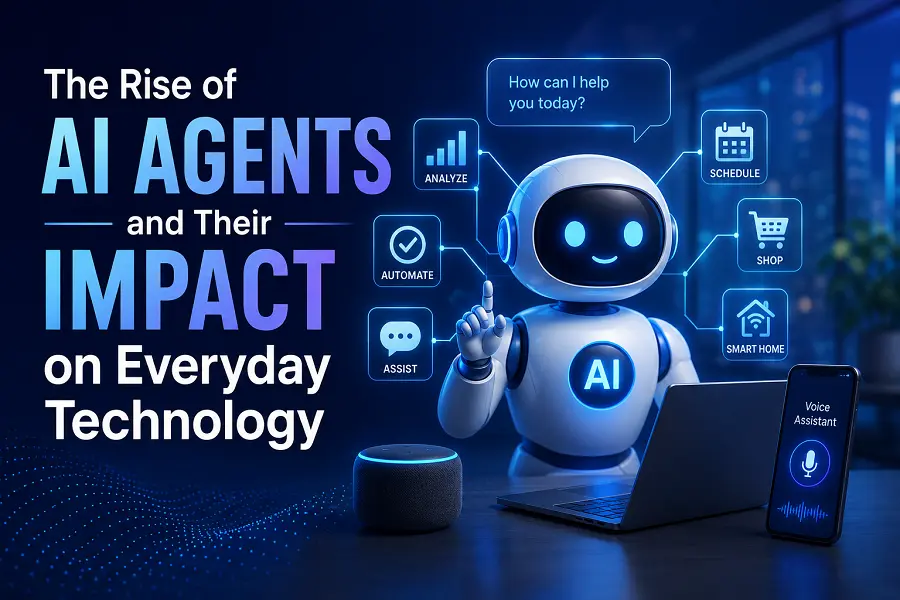
AI agents are changing the way people interact with technology by performing tasks with greater independence than traditional software. Instead of waiting for every command, these systems can understand goals, make decisions, and complete multi-step actions with minimal guidance. From managing schedules to assisting with customer support and smart home automation, AI agents are becoming part of everyday life. As they continue to evolve, they are making digital experiences faster, more personalized, and easier to manage.
How AI Agents Are Different from Traditional AI
Unlike basic AI tools that respond to a single request, AI agents can plan, reason, and adapt while working toward a specific objective. They can combine information from multiple sources, remember context, and choose the next action based on changing conditions.
Key characteristics include:
- Understanding user goals instead of isolated commands.
- Completing multi-step tasks with minimal supervision.
- Learning from previous interactions to improve future performance.
- Integrating with different applications and digital services.
- Responding to changing situations without constant user input.
These capabilities allow AI agents to act more like digital assistants that actively solve problems rather than simply answering questions.
Where AI Agents Are Making the Biggest Difference
AI agents are already improving daily activities across personal and professional environments.
1. Personal Productivity
They organize calendars, prioritize emails, summarize documents, and help users manage daily routines without switching between multiple apps.
2. Smart Homes
AI agents coordinate connected devices by adjusting lighting, controlling security systems, managing energy usage, and creating personalized home environments.
3. Customer Support
Businesses use AI agents to resolve common customer requests, process returns, schedule appointments, and provide round-the-clock assistance while reducing waiting times.
4. Education
Students benefit from personalized learning support through tailored explanations, study plans, progress tracking, and interactive practice sessions.
5. Healthcare Assistance
Although they do not replace medical professionals, AI agents can remind patients about medications, organize health records, schedule appointments, and simplify administrative tasks.
Practical Benefits and Future Considerations
As AI agents become more capable, users should understand both their advantages and the responsibilities that come with adopting them.
- Greater efficiency: Routine work is completed automatically, allowing people to focus on higher-value tasks.
- Better personalization: AI agents adapt recommendations and workflows based on individual preferences.
- Improved accessibility: Voice interaction and automation make technology easier for people with different abilities.
- Faster decision support: AI agents analyze large amounts of information and present useful insights quickly.
- Privacy awareness: Users should review permissions and control what personal information AI agents can access.
- Human oversight: Important financial, legal, or healthcare decisions should always include human judgment, even when AI provides recommendations.
Organizations that implement AI responsibly are more likely to build user trust while benefiting from improved productivity and better customer experiences.
The Future of AI Agents in Everyday Technology
The next generation of AI agents will move beyond individual tasks and coordinate entire digital workflows. Instead of opening several applications to complete a project, users may simply describe an objective while an AI agent handles planning, communication, scheduling, and execution.
Businesses are expected to use specialized AI agents for sales, marketing, customer service, software development, and operations. Consumers will increasingly rely on personal AI assistants that understand long-term preferences while respecting privacy controls.
Success will depend on balancing automation with transparency, security, and human oversight. The most valuable AI agents will not replace people but help them make better decisions, save time, and simplify complex digital activities.
Conclusion
AI agents represent a major shift in how people use technology every day. Their ability to understand goals, automate complex tasks, and adapt to user needs makes them far more capable than traditional software assistants. As adoption grows across homes, workplaces, education, and healthcare, AI agents will continue to reshape digital experiences. Users who understand both their capabilities and limitations will be better prepared to benefit from this new generation of intelligent technology.
FAQs
1. What is an AI agent?
An AI agent is an intelligent software system that can understand objectives, make decisions, and perform multiple tasks with minimal human guidance.
2. How do AI agents differ from chatbots?
Chatbots mainly answer questions, while AI agents can plan actions, complete workflows, interact with multiple systems, and adapt to changing situations.
3. Are AI agents safe to use?
They can be safe when built with strong privacy, security, and transparency features. Users should also review permissions and monitor sensitive activities.
4. Which industries benefit most from AI agents?
Healthcare, education, finance, customer service, manufacturing, and retail are among the sectors gaining significant productivity improvements.
5. Will AI agents replace human workers?
AI agents are more likely to automate repetitive tasks while allowing people to focus on creativity, decision-making, and complex problem-solving.