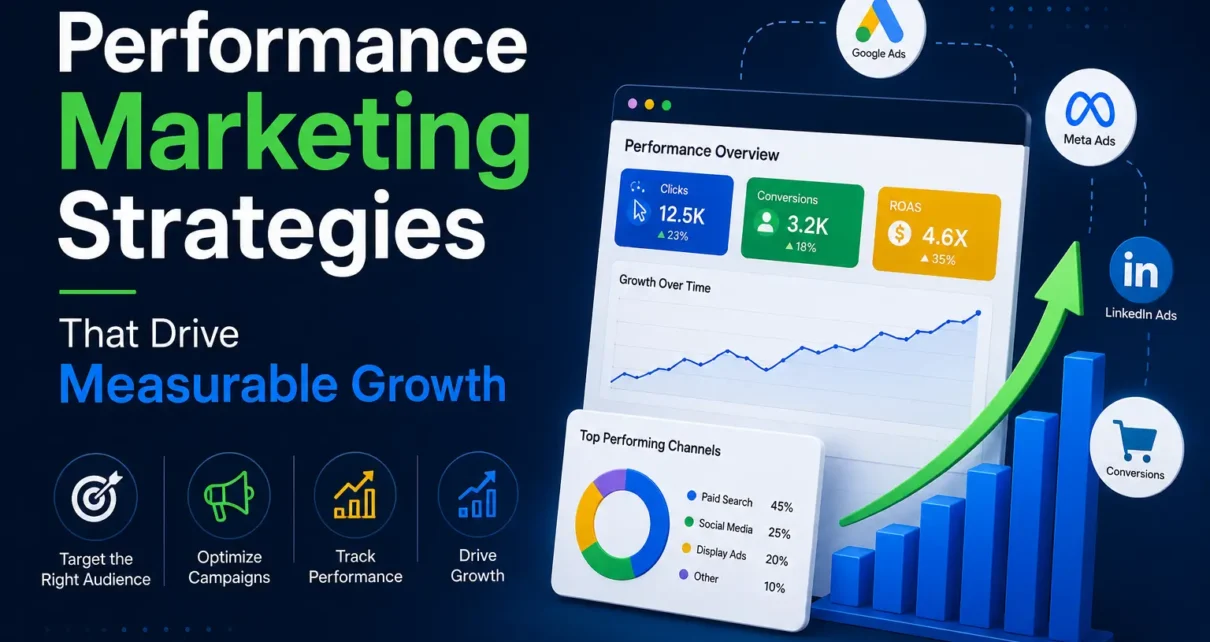
Performance marketing focuses on measurable results rather than assumptions. Every campaign is designed around specific business goals such as generating leads, increasing sales, improving app downloads, or boosting customer retention. Instead of investing in broad awareness alone, businesses track every click, conversion, and acquisition to understand what delivers the best return.
A successful performance marketing strategy combines accurate audience targeting, continuous testing, reliable tracking, and data-driven decision-making. When these elements work together, businesses can scale campaigns confidently while controlling costs and maximizing revenue.
Build a Strong Performance Marketing Foundation
Successful campaigns begin with clear objectives and accurate measurement. Without reliable tracking, even high-performing campaigns become difficult to evaluate.
Key elements include:
- Define measurable goals such as conversions, qualified leads, or purchases.
- Install conversion tracking across websites and landing pages.
- Create audience segments based on customer behavior and interests.
- Develop persuasive landing pages with clear calls to action.
- Align advertising messages with the user’s search intent.
- Monitor key metrics including conversion rate, customer acquisition cost, return on ad spend, and lifetime value.
- Use first-party data to improve audience targeting and personalization.
This structured approach reduces wasted advertising spend while creating a scalable framework for future growth.
Performance Marketing Strategies That Deliver Results
Not every strategy produces the same outcome for every business. Choosing the right combination depends on your objectives, industry, and customer journey.
- Optimize Paid Search Campaigns
Target high-intent keywords that indicate buying interest. Well-structured campaigns with relevant ad copy and optimized landing pages often generate qualified traffic with higher conversion potential. - Leverage Paid Social Advertising
Social platforms allow precise audience targeting based on demographics, interests, behaviors, and previous interactions. Retargeting campaigns can reconnect with visitors who left without converting. - Improve Landing Page Performance
Fast loading speeds, simple navigation, persuasive headlines, trust signals, and concise forms help increase conversion rates without increasing advertising costs. - Run Continuous A/B Testing
Test headlines, visuals, calls to action, pricing displays, and page layouts. Small improvements across multiple campaign elements often produce significant long-term gains. - Use Marketing Automation
Automated email sequences, lead nurturing, abandoned cart reminders, and personalized recommendations help convert prospects after their initial interaction. - Allocate Budget Based on Performance
Shift investment toward campaigns, audiences, and channels that consistently generate profitable results instead of distributing budgets evenly.
Measuring, Scaling, and Sustaining Growth
Performance marketing is an ongoing optimization process rather than a one-time campaign. Regular analysis helps identify opportunities for improvement while reducing ineffective spending.
Focus on metrics that directly support business growth instead of vanity numbers. High impressions or clicks mean little if they do not contribute to conversions and revenue.
As campaigns mature, refine audience segments, refresh creative assets, improve bidding strategies, and expand into new channels only after validating profitability. Scaling gradually while maintaining close performance monitoring helps preserve return on investment.
Businesses that consistently analyze customer behavior, optimize campaigns, and adapt to market changes are better positioned to achieve sustainable, measurable growth over time.
Conclusion
Performance marketing succeeds because every decision can be measured and improved. Clear objectives, reliable tracking, audience targeting, continuous testing, and ongoing optimization create campaigns that generate predictable business results. Rather than relying on guesswork, organizations can invest confidently in strategies that consistently improve conversions, revenue, and long-term profitability.
FAQs
1. What is performance marketing?
Performance marketing is a digital marketing approach where advertisers pay based on measurable actions such as clicks, leads, sales, or conversions.
2. Which metrics are most important in performance marketing?
Key metrics include conversion rate, cost per acquisition, return on ad spend, click-through rate, customer lifetime value, and overall revenue generated.
3. How does A/B testing improve campaign performance?
A/B testing compares different versions of ads or landing pages to identify which elements produce better conversion rates and stronger business outcomes.
4. Is performance marketing suitable for small businesses?
Yes. Small businesses benefit from measurable spending, targeted advertising, and the ability to optimize campaigns based on real performance data.
5. How long does it take to see results from performance marketing?
Initial insights can appear within days, while meaningful optimization and sustainable growth typically develop over several weeks as campaign data accumulates.