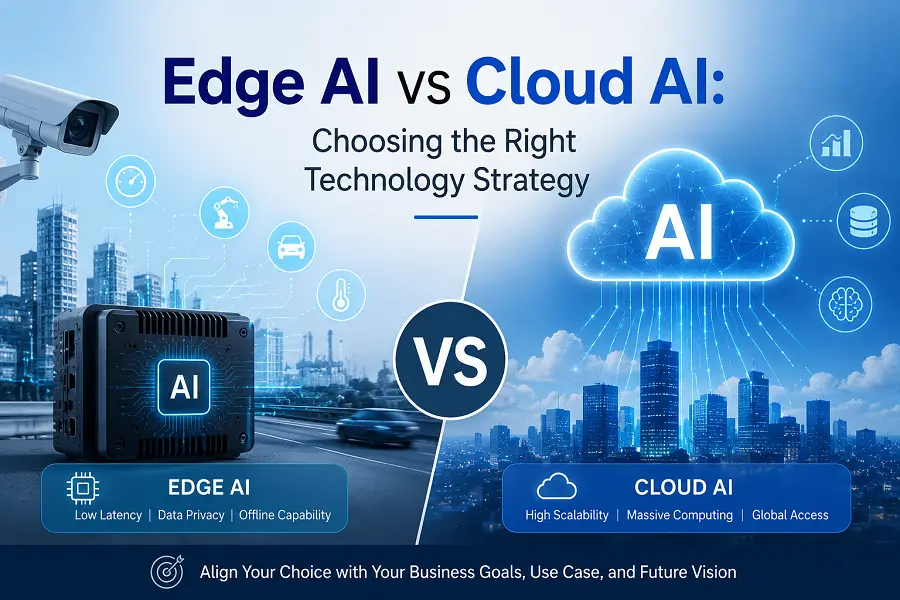
Artificial intelligence is no longer limited to large data centers. Businesses can now run AI models directly on devices or process them through powerful cloud platforms. The right approach depends on how quickly decisions must be made, how sensitive the data is, and how much computing power an application requires. Understanding the strengths and trade-offs of Edge AI and Cloud AI helps organizations build solutions that balance speed, cost, security, and scalability.
Edge AI: Processing Intelligence Where Data Is Created
Edge AI performs data processing directly on devices such as smartphones, industrial sensors, cameras, medical equipment, and autonomous machines. Instead of sending every piece of information to a remote server, the device analyzes data locally and produces immediate results.
Benefits of Edge AI
- Delivers extremely low response times for real-time applications.
- Reduces internet bandwidth usage by processing data locally.
- Continues operating even with limited or unstable connectivity.
- Improves privacy by keeping sensitive information on the device.
- Lowers dependence on continuous cloud communication.
Edge AI is particularly valuable in manufacturing, healthcare, transportation, retail, and smart cities where rapid decisions can improve safety, efficiency, and customer experiences.
Cloud AI: Leveraging Centralized Computing Power
Cloud AI processes data in remote servers equipped with powerful computing resources. It enables organizations to train complex machine learning models, manage massive datasets, and deploy AI services across multiple locations without investing heavily in local hardware.
When Cloud AI Is the Better Choice
- Large-scale data analysis requiring significant computing resources.
- AI model training with constantly growing datasets.
- Applications that serve users across different regions.
- Businesses needing centralized monitoring and management.
- Projects requiring frequent software updates and model improvements.
Cloud AI also makes collaboration easier because teams can access shared models and datasets from virtually anywhere. This flexibility supports faster development and continuous innovation.
How to Choose the Right AI Strategy
Selecting between Edge AI and Cloud AI should begin with business requirements rather than technology trends.
If your application demands instant decision-making, Edge AI offers a clear advantage. Examples include autonomous vehicles, predictive maintenance systems, and security cameras that must detect events without delay.
When processing vast amounts of information or training advanced AI models, Cloud AI provides greater computing capacity and easier scalability. It is well suited for customer analytics, recommendation engines, fraud detection, and enterprise reporting.
Many organizations achieve the best results with a hybrid strategy. Devices perform immediate local analysis while sending selected data to the cloud for deeper insights, long-term storage, and continuous model improvement. This combination reduces latency while preserving the benefits of centralized AI management.
Other factors worth evaluating include deployment costs, hardware limitations, regulatory requirements, maintenance complexity, cybersecurity needs, and expected future growth. A technology strategy that fits current needs while supporting expansion often delivers the highest long-term value.
Conclusion
Neither Edge AI nor Cloud AI is universally better. Each addresses different operational challenges and business goals. Edge AI excels in real-time performance, privacy, and offline functionality, while Cloud AI offers unmatched scalability, computing power, and centralized management. Organizations that carefully assess performance requirements, data sensitivity, infrastructure, and long-term objectives can select the AI strategy that delivers the greatest business impact. In many cases, combining both technologies creates a flexible and future-ready AI ecosystem.
FAQs
1. What is the main difference between Edge AI and Cloud AI?
Edge AI processes data directly on local devices, while Cloud AI performs processing in remote cloud servers using centralized computing resources.
2. Which AI approach is faster?
Edge AI generally provides faster response times because data does not need to travel across the internet before being processed.
3. Is Edge AI more secure than Cloud AI?
Edge AI can improve privacy by keeping sensitive data on the device, although both approaches require strong security practices to protect information.
4. Can businesses use both Edge AI and Cloud AI together?
Yes. A hybrid AI architecture combines local processing with cloud-based analytics, offering both real-time performance and centralized intelligence.
5. Which industries benefit most from Edge AI?
Manufacturing, healthcare, automotive, retail, logistics, smart cities, and industrial automation commonly benefit from Edge AI because they often require immediate decision-making.