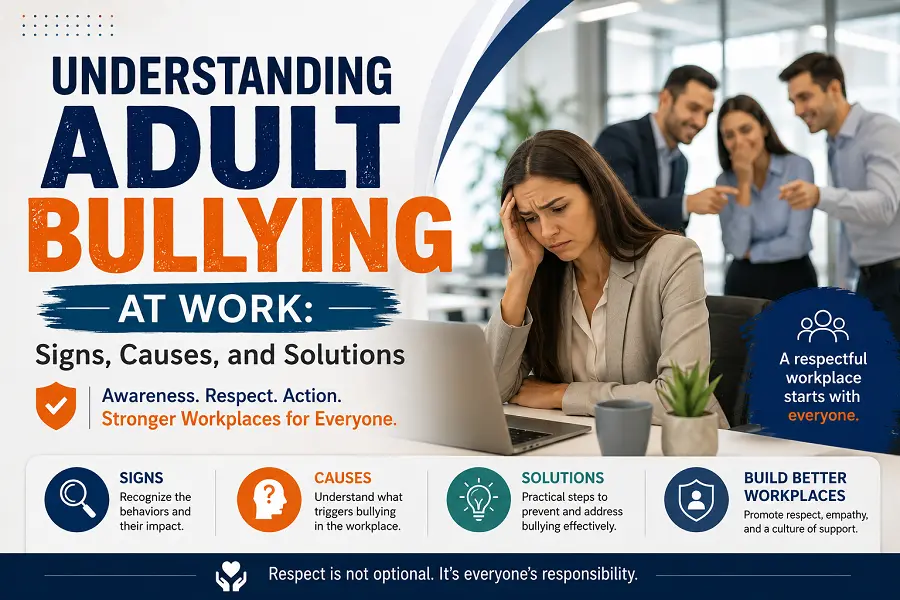
It’s Not Just a Playground Problem Anymore
Somewhere along the way, most of us assumed bullying was something you left behind in middle school. Then you get your first “real” job, sit through your first team meeting, and realize the guy interrupting you every single time you speak isn’t just “assertive” — he’s doing exactly what the kid on the bus used to do, just with a laptop and a job title.
Adult bullying at work isn’t rare. It isn’t a personality clash you need to “just get over.” And it isn’t something that only happens in dramatic, obvious ways like shouting matches in the break room. Most of the time, it’s quieter than that — and that’s exactly what makes it so hard to name, let alone fix.
I’ve spent time talking to HR professionals and reading through case studies on workplace conduct, and one thing keeps coming up: the people experiencing it often doubt themselves before they doubt the bully. That self-doubt is the first thing we need to address.
What Adult Bullying at Work Actually Looks Like
Forget the Hollywood version — the screaming boss throwing papers across a desk. Real workplace bullying is usually built from small, repeated moments that are easy to dismiss individually but devastating in pattern.
Here’s what it tends to look like in an ordinary adult workplace:
- Being consistently left out of meetings or emails you should be part of
- A coworker taking credit for your work, then acting confused when you bring it up
- Constant, unnecessary criticism — even when the work is solid
- Someone spreading half-true rumors about your performance or attitude
- Public correction for mistakes that would normally be handled privately
- Sarcastic “jokes” that always seem to land on you specifically
- Sudden silence or coldness the moment you walk into a room
None of these, on their own, scream “bullying.” That’s the trick. It’s the repetition and the pattern that turns ordinary workplace friction into something else entirely.
Why Do Adults Bully in the Workplace?
This is the question people ask most, and honestly, it’s the one with the least satisfying answer: it’s rarely about you.
Adults who bully at work are often insecure, threatened, or simply used to getting their way through intimidation because it’s worked for them before — sometimes for years. A manager who bullies a direct report is frequently terrified of being outperformed. A coworker who undermines you in meetings might be doing damage control for their own shaky position. Bullying, at its core, is usually a control problem wearing a confidence costume.
There’s also a structural piece to this that doesn’t get talked about enough. Some workplaces genuinely reward this behavior. If a manager hits their numbers by browbeating a team into overworking, and leadership only looks at the numbers, that manager gets promoted. The bullying isn’t punished — it’s quietly endorsed. I’ve seen this pattern in more than one company: results get praised, methods get ignored.
A smaller but real factor is generational and training gaps. Someone who was managed poorly themselves, and never taught how to give feedback constructively, often repeats what was modeled for them. That doesn’t excuse it. But it does explain why some bullies genuinely don’t see themselves as bullies at all.
Who Tends to Get Targeted
Bullies are usually strategic, even if not consciously. They tend to go after people who are less likely to fight back publicly — new hires still finding their footing, quieter personalities, people from underrepresented backgrounds, or anyone who recently had a personal setback that made them more vulnerable.
Interestingly, high performers get targeted too. A talented, well-liked colleague can become a threat to someone insecure about their own position. If you’ve ever been bullied right after a big win — a promotion, a great review, landing a major client — that’s not a coincidence.
How This Connects to ADHD, Learning Styles, and Adult Workplace Dynamics
Here’s something that doesn’t get discussed nearly enough: neurodivergent adults, including those with ADHD, are disproportionately targeted by workplace bullies. Traits like difficulty with time management, occasional forgetfulness, or a non-linear way of communicating ideas get misread as laziness or incompetence — when in reality, many ADHD adults bring real strengths to the workplace: creative problem-solving, high energy during periods of interest, and an entrepreneurial instinct for spotting opportunities others miss. A lot of ADHD adults thrive in workplace roles or run their own businesses precisely because that environment lets their strengths lead instead of forcing them to mask their differences.
The same misunderstanding shows up in how adults learn on the job. Not everyone absorbs new processes the same way — some need hands-on repetition, others need to see the bigger picture first, some need written instructions instead of a rushed verbal walkthrough. When managers don’t know how to train adults in the workplace using more than one method, the employees who need a different approach often get labeled as “slow” or “not getting it,” which becomes fresh ammunition for a bully looking for a reason.
The Real Cost of Staying Quiet
I want to be honest here instead of just reassuring — because pretending this is simple would be doing you a disservice.
Speaking up about workplace bullying doesn’t always fix things immediately, and sometimes it makes the situation more tense before it improves. That’s a real risk, not a scare tactic. But staying silent has costs too — chronic stress, disrupted sleep, dread on Sunday nights, and in some cases, people quitting jobs they were otherwise good at and enjoyed. Weigh both sides honestly before deciding your next move; there’s no single “right” answer that applies to everyone.
What You Can Actually Do About It
1. Document Everything, Immediately
Don’t rely on memory. Write down dates, exact quotes where possible, who else was present, and how it affected your work. This isn’t paranoia — it’s the single most useful thing you can hand HR or a lawyer if things escalate.
2. Name It Calmly, In the Moment (If It’s Safe To)
Sometimes a simple, flat “that comment wasn’t necessary” in front of others is enough to disrupt the pattern, because bullies often rely on nobody pushing back. This won’t work with every bully — some will just get sneakier — but it’s worth trying early before the pattern becomes entrenched.
3. Build a Paper Trail With HR, Not Just a Conversation
A casual chat with HR can get forgotten or downplayed. Follow it up with an email summarizing what you discussed. It protects you and creates accountability.
4. Find Your Allies Quietly
You’re probably not the only target. Bullies rarely limit themselves to one person. A quiet, careful conversation with a trusted coworker can confirm you’re not imagining things — and shared documentation is far more powerful than a single account.
5. Know When to Walk Away
This one’s hard to hear, but sometimes the healthiest option is leaving, especially if leadership has shown you they’ll protect the bully over you. Staying to “win” a fight against a toxic culture can cost more than it’s worth.
A Quick Word for Employers and Managers
If you’re on the other side of this — running a team, hiring, building culture — the fix starts before bullying ever happens. Train managers on how to give feedback that doesn’t rely on public shaming. Build in more than one way of training adults in the workplace, since a one-size-fits-all onboarding process quietly punishes people who learn differently. And pay attention when your top performer suddenly goes quiet in meetings — that shift is rarely random.
The Bottom Line
Adult bullying at work is real, common, and often invisible to everyone except the person experiencing it. It’s rarely about your competence and usually about someone else’s insecurity or a workplace culture that rewards the wrong behaviors. You can’t always control whether it happens to you, but you can control how you document it, who you loop in, and when you decide enough is enough.
Frequently Asked Questions
1. What counts as adult bullying at work?
Any repeated pattern of behavior meant to intimidate, humiliate, or undermine a coworker — including exclusion, public criticism, credit-stealing, and rumor-spreading.
2. Is workplace bullying the same as harassment?
Not legally, in most places. Harassment usually involves a protected characteristic (race, gender, disability, etc.), while bullying can happen for any reason, which sometimes makes it harder to escalate legally.
3. Why do adults bully in the workplace if they’re supposedly “mature”?
Age doesn’t erase insecurity or poor conflict-management habits. Many workplace bullies are repeating behavior that was rewarded or modeled for them earlier in their careers.
4. Can a manager be a workplace bully?
Yes, and it’s actually one of the most common forms, since managers hold power over schedules, reviews, and promotions.
5. How do I know if I’m being bullied or just given tough feedback?
Tough feedback is specific, private, and focused on improving the work. Bullying is repetitive, often public, and focused on you as a person rather than the task.
6. Are ADHD adults more likely to be bullied at work?
Evidence and workplace reports suggest neurodivergent employees, including those with ADHD, are targeted more often because their traits get misread as incompetence rather than understood as a different working style.
7. What should I document if I’m being bullied?
Dates, times, exact words used, witnesses present, and how each incident affected your work or wellbeing.
8. Should I confront the bully directly?
It depends on the power dynamic and your comfort level. A calm, factual statement can work with peers but may backfire with a bullying manager who controls your role.
9. What if HR doesn’t take it seriously?
Keep your documentation, follow up in writing, and consider whether external resources (employment lawyer, labor board) make sense for your situation.
10. Can workplace bullying affect mental health?
Yes — chronic workplace bullying is linked to anxiety, depression, sleep problems, and burnout in multiple studies on occupational stress.
11. How do adults learn best in the workplace when it comes to conflict training?
Most adults retain conflict-resolution and anti-bullying training better through scenario-based practice and discussion rather than a one-time slideshow presentation.
12. Is it normal to consider quitting over workplace bullying?
It’s common, and sometimes it’s the right call — especially if leadership consistently protects the bully over the target.
13. Can bullying happen between coworkers of equal rank, not just boss-to-employee?
Absolutely — peer-to-peer bullying is extremely common and often flies under the radar because there’s no obvious power imbalance to flag.
14. What role does company culture play in adult workplace bullying?
A big one. Cultures that reward results without questioning methods often unintentionally protect bullies who “get things done.”
15. How can employers reduce bullying in the workplace?
By training managers on constructive feedback, offering multiple ways to train adults in the workplace, and taking early complaints seriously instead of waiting for a major incident.